Cognitive Alignment at No Cost
Vision Transformers (ViTs) now sit at the centre of state-of-the-art image recognition, but their internal attentional behaviour still differs markedly from human visual attention. That gap matters because a model can be highly accurate while prioritising image regions in ways that appear unintuitive, brittle or difficult to interpret.
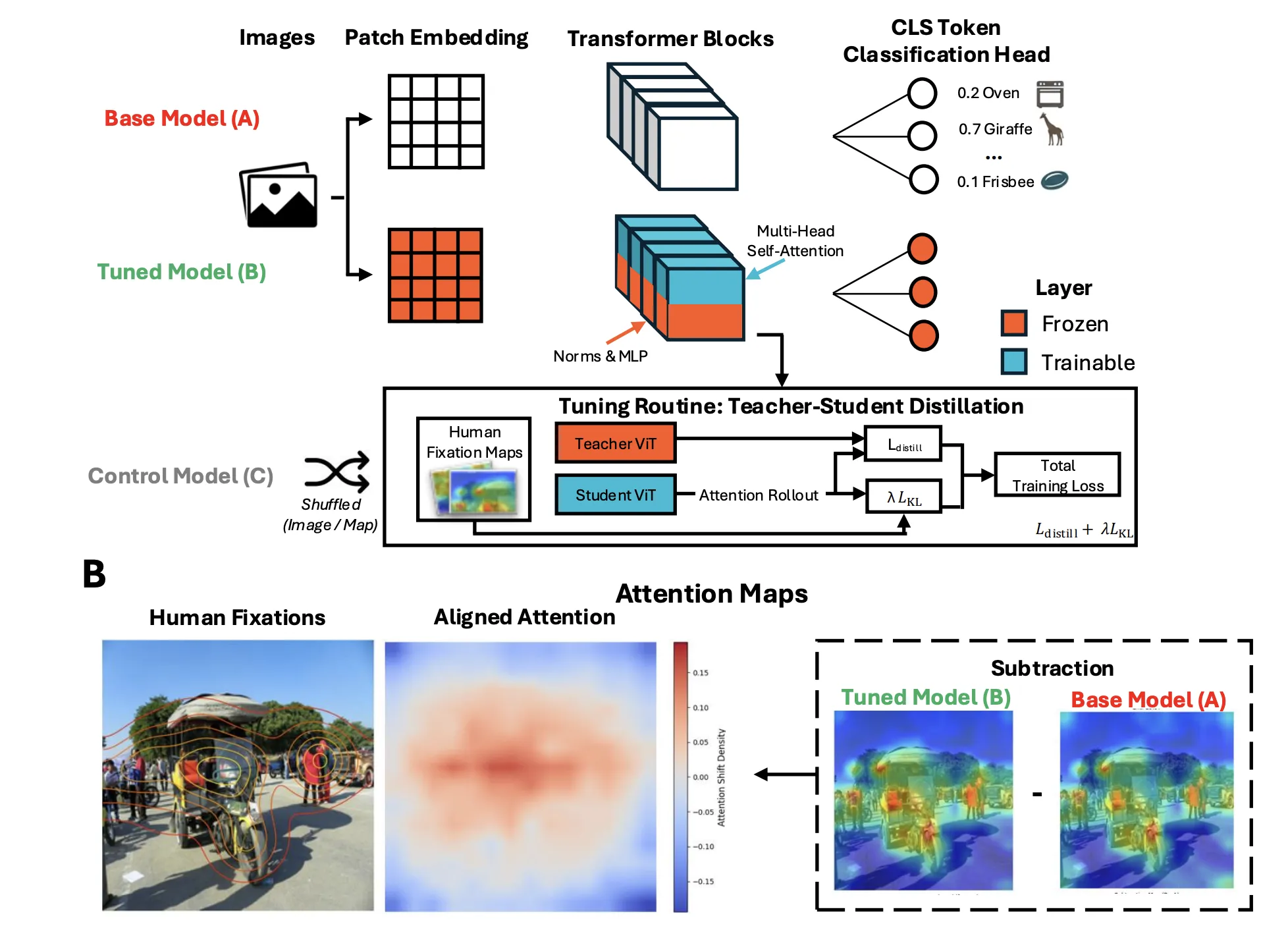
A recent paper, Cognitive Alignment At No Cost: Inducing Human Attention Biases For Interpretable Vision Transformers, asks a simple but important question: can we make a ViT attend to images more like humans do, without harming its classification performance?
Aligning attention with human saliency
To test this, the authors fine-tuned the self-attention weights of Google's ViT-B/16 using human fixation-based saliency maps. The goal was not to retrain the model from scratch or alter its task objective, but to introduce a biologically grounded attentional prior into an already capable architecture.
Crucially, the study also included a shuffled-control baseline. That comparison helps isolate whether any observed effects arise from meaningful human attentional structure, rather than from generic additional supervision.
What changed in the model
Fine-tuning improved alignment with human saliency across five evaluation metrics and induced several recognisably human-like attentional tendencies.
First, the aligned model reversed the baseline tendency to favour larger objects, showing greater sensitivity to smaller but semantically informative regions. Second, it strengthened an animacy bias, prioritising humans and animals more consistently than background content. Third, it reduced extreme attention entropy, producing sharper and more interpretable peaks of attention.
Taken together, these changes suggest that the model's attention became not just different, but more cognitively plausible.
No measurable cost in accuracy
Interpretability interventions often come with an implicit trade-off: if we constrain a model to behave in a more human-like way, we may expect some drop in task performance. This paper presents evidence against that assumption, at least for ViTs.
Using Bayesian parity analysis, the authors report decisive to very strong evidence that the cognitively aligned model preserved its original classification performance on standard in-distribution, corruption-robustness and out-of-distribution benchmarks, namely ImageNet, ImageNet-C and ObjectNet.
In other words, the model became more human-aligned in where it looked, without becoming worse at what it predicted.
Why the architecture matters
The comparison with a ResNet-50 is especially revealing. Applying an equivalent alignment procedure to the CNN did not produce the same benefit. Instead, it degraded both saliency alignment and classification performance.
This contrast suggests that the ViT's modular self-attention mechanism may be particularly well suited to separating spatial prioritisation from representational logic. If so, transformer architectures may allow biologically grounded priors to be introduced into attention without disrupting the core features that support recognition.
Why this matters
The broader implication is not simply that human-like attention looks nicer in visualisations. Rather, it suggests that cognitive alignment may be achievable as a low-cost property of model design and fine-tuning, rather than as a trade-off against capability.
If that result holds across other settings, it strengthens the case for building models that are not only accurate, but also more legible in the terms humans naturally use to understand visual behaviour. For interpretability research, that is a meaningful shift: biological plausibility may not be a constraint on performance, but a useful design principle for improving transparency.